

The Great Betrayal
How Patriarchy Conned Us and How We Get to the Other Side

My mother has always been the most beautiful woman in the room, so when my father met her in a college dorm, I imagine that the light playing starlight in her eye made my 5-foot-9 father feel like Orion. My father held the primal power of life and death in his hands. He was a wide-shouldered boxer channeling that two-edged power as a doctor serving his residency at San Francisco General Hospital. Within a patriarchal society, he was all the safety America had promised my mother when she immigrated from Nigeria.
My father impregnated my mother and proposed marriage. He vowed to protect her. She swore to obey him. They both repeated a lie they’d learned from the Western stories that teach us love, a lie that turned their vows to glass.
My mother rescued herself from their jagged promises by divorcing my abusive father when I was three-years-old.
I spend a lot of time thinking about my father, about all the fathers blindly following patriarchy for the past 2,000 years. I think, with equal parts rage and grief, about how the architects of this ideology convinced men so full of life-giving love to buy into a system that demeans, dominates, and kills women. When my parents married in the 1970s, 66 percent of Americans believed that a woman’s place was in the home. Patriarchy, its strict gender roles, lurks at the root of this belief. This belief demeans because in capitalism, the person who makes money is socially superior to the person who doesn’t. The belief dominates women because it takes their sovereignty and forces dependence on men. One result of this normalized dependence with its attendant power dynamics is a man kills a woman in their family every eleven minutes.
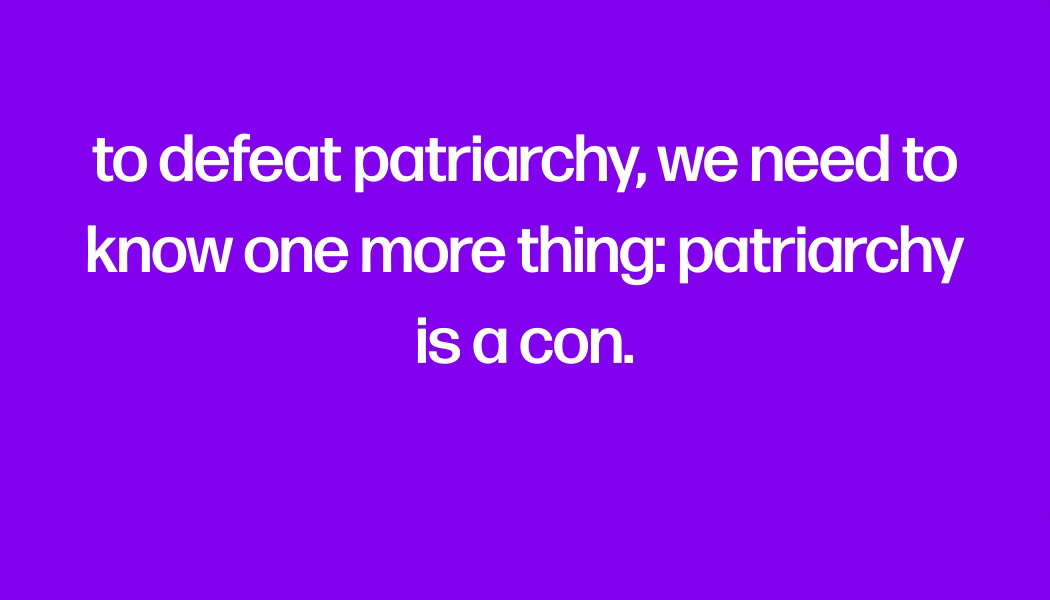
What is patriarchy? It’s multifaceted, and most definitions I come across tend to focus on one facet. Both Darnell Moore and bell hooks define it as a political-social system that insists that males are inherently dominating, superior to everything deemed weak, and this domination is the cost of admission to the category of “man.” Dr. Carol Gilligan focuses on another facet of patriarchy by examining how its hierarchies and modes of enforcement not only divide us from our communities, but they divide us from ourselves — which is why contemporary men feel so isolated. Moore, hooks, and Gilligan all argue that the premises of patriarchy are false and harmful, but I want to add something explicit to the definition of patriarchy. Yes, it’s a political-social system of unjust domination that divides us from ourselves and the people we want to love. But to defeat patriarchy, we need to know one more thing: patriarchy is a con.
The distinction between a con and a false premise is important because a con requires a more comprehensive strategy to defeat. False premises often come to us through institutions and cultural learnings. Exposing them calls for education and corrected belief. Cons, on the other hand, come to us through someone we trust. Many of us received patriarchy from parents acting in good faith, and our parents received it from their parents. The architects of patriarchy exist so far back in history that if we tried to trace the lineage of patriarchy in our lives, it’s unlikely we could identify a bad actor. Liberating our communities from patriarchy, then, requires not only corrected beliefs but an acknowledgement of what we’ve lost to a betrayal diffused so widely across our family and community structures that the bad actor is essentially an invisible hand. It requires a grieving process, a movement to recover our agency, and it requires empathy for ourselves and for the people still conned by the ideology. Without this or another more comprehensive approach, without understanding the problem clearly enough to identify the right tools to solve it, I fear patriarchy will persist.
❧
When I was growing up, my father had two best friends. Uncle Jerry was a white man who used to chase my brothers and I around the house, swoop us up in his burly arms, and scrub our giggling faces with his sandy beard. Uncle Ted was a Black attorney who conned my father for over 20 years. My father had a dream of a nonprofit that supported Black communities’ healthcare and education, and Ted promised a pathway to this dream. My father bought into the con because it promised the fulfillment of his deepest longings – a safer world for Black children.
My father paid into this con through two bankruptcies, a mortgage foreclosure; he paid until the day he died living illegally in his office because he couldn’t afford both a home and a business. He borrowed money repeatedly from Uncle Jerry and other intimates until all of his relationships broke. My father became more and more isolated, but in his heart, he and Ted were saving the world together, and nobody – not his children, not Jerry – nobody but Ted would understand his sacrifice until he finally reached the dream.
Ted delivered the near enemy of my father’s dream. “Near enemy” is a concept Buddhists use to understand emotions, but it’s useful in understanding social dynamics too. The far enemy of love is easy to see: hate. The near enemy of love might be possessive attachment which is harder to see than hate because it can look like love, but it actually undermines the respect and empathy necessary to sustain love. My father’s dream was material safety for Black families. He inherited this dream from our ancestors – his grandparents, Malcolm X, Bob Marley and Huey P. Newton. Ted perverted the language of collective uplift to sell my father the near enemy of his devotion to Black families: martyrdom. My father confused devotion with martyrdom, and instead of protecting Black families from a predatory world, he condemned his own family to poverty and insecurity. He betrayed his children, and we discovered it when we biked to our community bank only to discover that our father had stolen all the money we’d saved in our short lives to invest in what we’d known was a con since I was nine years old. I never forgave my father; he lost his children that day.
Ted promised a dream but delivered a near enemy. It wasn’t a simple false premise which is essentially a bad roadmap. A con is a rigged transaction. It says, “Give me your genuine hunger for X,” but it only delivers a near enemy that keeps us hungry, loyal, and paying. Patriarchy operates in the same way. It identifies our deepest human needs – to feel safe, to feel loved, to feel important – and offers their near enemies – domination instead of safety, submission instead of feeling loved, superiority instead of feeling valued. These counterfeits feel close enough to the real thing, especially when everyone around you insists they are, but they just leave us more hungry, more disconnected from our dreams, and more invested in the lie.
This is the architecture of a con. My father lived and died inside Ted’s lie. And he lived and died inside another version of the same con: patriarchy.
I saw through patriarchy for the first time in my 30s while serving a life sentence in prison. I sat on my top bunk watching TV. TV and music were my windows into experiencing emotions beyond anger, fear, and lust in a prison environment that had little tolerance for love, kindness, and honest yearning. I don’t remember exactly what I was watching. It might have been a loving couple working through difficulties, and I remember an intense desire for love and acceptance, a desire to be this TV couple. I knew that I’d always wanted that, but despite having sought it all my life, I’d never had the chance. Nobody I loved really knew me. They knew only a performance of who I thought I needed to be as a man, and that performance – not racism, not poverty, not even incarceration – had been the thing keeping me from the connection I craved. I cried for both the realization that patriarchy had tricked me into defeating my own dream and the realization that with a life sentence, I might never have the opportunity to find the love I wanted.
That was the moment I rejected patriarchy, but rejection alone is a void. I had to find something on which to build a different way. I started with the only logic I had access to at the time, the logic of war and domination: the enemy of my enemy is my friend. Since patriarchy had been at war with my full spectrum of feelings – my vulnerability, my fear – they must be my best allies. I began to sit with the loneliness instead of transmuting it into rage. Rather than distorting myself into a tough-guy performance, I let my fear teach me about my desires. It wasn’t therapy; it was a tactical alliance in which I recruited internal allies against a shared oppressor.
I didn’t have the words “near enemy” yet. I just saw the repeated, cruel joke: we were all reaching for one thing – connection, respect, or safety – but our beliefs about what made a good man kept giving us the opposite – isolation, shame, and violence. Years later, when I learned the Buddhist concept of “near enemy,” it gave me the perfect framework to name what I’d spent decades studying in the prison of my own life.
❧
I grieve for myself and for my father. From that grief, I take my task as not shaming men for the desires the con exploited but co-creating a world where we fulfill those desires in life-giving ways. This is a shift that means supporting each other to find not just outlets for our desires but celebrated roles where our strength creates access, our protectiveness fosters safety, and our need to matter answers itself in becoming vital to our communities’ flourishing.
My favorite example of this shift is the home where I live with two women I love like sisters. I think we all get a kick out of them asking me to open a tight-lidded jar. My body is full of physical power, more power than I know what to do with. I often watch dogs chewing on hard sticks for no other reason but to crush them to splinters. I empathize. Their ancestors gave them powerful jaws to crack the bones of thousand-pound moose, but that power has no purpose for most dogs in the 21st century. That’s how I sometimes feel about my physical strength, so when one of my housemates nests a jar with a too tight lid in my hands, it’s a special moment. My hands tighten and twist. The jar resists; my elbows raise to align with the jar; my body grounds through my knees and aligns to this single purpose. When the top pops, a thrill rushes from my palms to my feet. Then there we are: an open jar of food, a thankful housemate, and a proud me.
In my communities, many women have stopped asking cis men for their muscles in order to protect themselves from inviting the male dominance often attached to minor requests for help, so the first time a housemate asked me to open a jar, I played it cool, like my elated inner child wasn’t shouting “I’m a useful man” from a mountaintop – read, “I feel important!” I opened the jar, left the kitchen, and then stopped. I returned to the kitchen, confessed how amazing I felt, and we both laughed with the joy that only an inner child can inspire.
In the kitchen, I experienced what I’ll call power in service to life. I felt my inherited physical strength become a tool that creates access for someone who’d inherited a different set of strengths. I experienced my need to matter satisfied by becoming vital to a shared moment. This is the shift in our social script – strength fostering safety, need building community – that I hope to help institutionalize to disrupt patriarchy’s con.
And the old con doesn’t vanish. It lays in ambush waiting for a threat – a moment when it can sell you the near enemy of your best instinct. Last spring, a beloved community member – I’ll call them Bren – broke up with an abusive male partner and I worried that this abusive person would come to my house looking for Bren. I asked my housemates to call me immediately if this happened. That same week, I met with this abuser in an attempt at restorative justice, and after talking to him for ten minutes, I felt so afraid about the ways he would continue to harm my community member that I wanted to beat him bloody in the middle of a kava bar. Was that my protective instinct?
When I asked my housemates to call me if Bren’s abuser showed up at our house, I worried the abuser’s misogyny would endanger my housemates. I did feel protective. My housemates didn’t necessarily need my protection because they have exponentially more experience diffusing the ticking bomb of misogynist men than I do, but I felt and honored my feeling. When I met the abuser in a kava bar and wanted to punch him in the face, I felt the near enemy of my protective instinct – the urge to dominate. It would’ve been easy for me to beat an abuser and convince myself that I’d been overprotective. That would’ve been me confusing my commitment to my friend’s safety with its near enemy in a similar way that my father confused his commitment to my mother’s protection with domination. That moment with my friend’s abuser wasn’t about my protecting anyone. It was about me wanting to control the abuser’s future behavior through conquest, and that realization is the seed of a different world.
I live in that world now in a community called Sanctuary. Every day, I wake up to the blissful feeling of living in right relationship with my intimates and Mother Earth. This feeling: it’s too new for me to articulate, but I can describe pieces of it. I’m 46 years-old, and it’s the first time I’ve felt “at home.” It’s the joy of feeling women’s trust, a healing from the devastation I felt the first time I heard the women of my species were more afraid of me than a bear. It’s an unburdening. Men kill themselves more than women, and the prime beneficiaries of patriarchy – white men – kill themselves more than anyone. I feel free from those dynamics that drive male loneliness and suicide, and that feels like breathing after a lifetime of drowning. Most of all, I feel connected to Mother Earth’s forgiveness, love, and her excitement for the life I have on the other side of the betrayal.
This essay is the centerpiece of a larger resource—a facilitator’s guide and 4-week study companion for men ready to stop performing and start living. If you’d like to go deeper, or if you’re part of a group that could use this work, you’ll find it at the link below.
Thanks for reading The Great Betrayal. If this essay moved you, please share it with someone who needs it.
The Other Side: A Complete Resource Guide for the Great Betrayal
· Pay what you can for individuals
· 100% rebates available for facilitators
· Licenses for facilitators, groups, organizations, and institutions.